

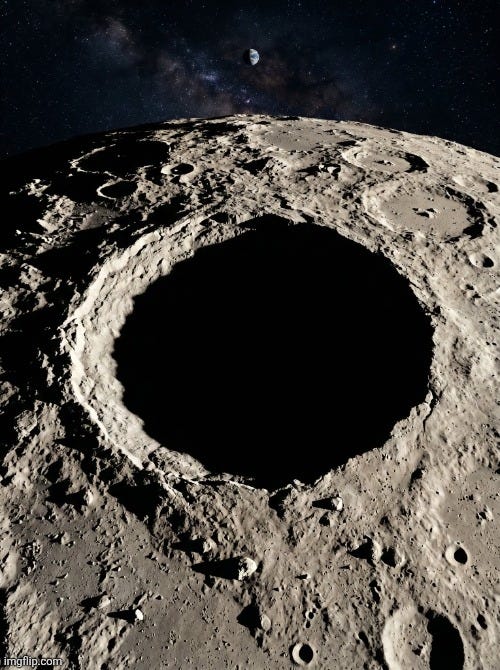
Shackleton Crater
China stands on the threshold of a new chapter in lunar exploration as it prepares to send the Chang’e-7 mission toward the Moon’s south pole, a region long regarded as one of the most scientifically precious and strategically vital places in the solar system. Scheduled for launch in the final days of August 2026 atop a Long March 5 rocket from the Wenchang Space Launch Site, this complex multi-spacecraft endeavor represents China’s most ambitious robotic lunar undertaking to date and a clear statement of intent to lead the next era of sustained presence on another world.
The mission architecture itself is a masterclass in coordinated exploration. An orbiter will circle the Moon, mapping the polar terrain in high resolution and guiding the final approach. A lander will attempt a precision touchdown on an illuminated ridge near the rim of Shackleton crater, a location chosen for its near-continuous sunlight that can power solar arrays while placing permanently shadowed regions only a short distance away.
From the lander, a rover will roll across the sunlit surface, studying the local geology and environment. The true innovation, however, lies in a small hopping probe equipped with thrusters. This agile scout will leap into the extreme cold and darkness of nearby craters, places no wheeled vehicle can safely reach, drill into the frozen regolith, and analyze samples for the presence of water ice and other volatiles that have remained locked away for billions of years.
These permanently shadowed regions are among the coldest spots in the solar system, natural cold traps that may hold the key to future human activity on the Moon. Water ice could be transformed into drinking water, breathable oxygen, and rocket propellant, turning the lunar surface from a desolate outpost into a place where explorers can live off the land.
Chang’e-7 is designed to answer fundamental questions about how much ice exists, how it is distributed, and whether it can be practically extracted. In doing so, the mission lays essential groundwork for the International Lunar Research Station that China and its partners envision near the south pole, and for the nation’s goal of landing astronauts on the Moon by around 2030.
Supported by the already-orbiting Queqiao-2 relay satellite, Chang’e-7 will operate with unprecedented communication capability, allowing continuous contact even when the south polar regions face Earth. The mission carries a suite of sophisticated instruments, some contributed by international partners, to examine surface composition, magnetic and thermal properties, and the broader lunar environment. Every measurement will deepen humanity’s understanding of the Moon’s history while simultaneously evaluating sites for long-term habitation.
The Chang’e program serves as China’s counterpart to the spirit of Artemis: a deliberate, multi-phase campaign that moves beyond brief visits toward a lasting presence. Where earlier Chang’e missions proved the ability to orbit, land, roam, and return samples, this latest chapter focuses on the resources and technologies required to stay.
The south pole is no longer merely a destination for exploration; it is becoming the foundation for a new chapter of human activity beyond Earth. As the Long March 5 stands ready on the pad in Hainan, China prepares to take a decisive step into that future, carrying the hopes of a nation and the curiosity of the world toward the Moon’s most mysterious frontier.