

The race for the heavens no longer features the faded banners of the old Soviet order. Where once the red star of Moscow burned brightest against American ambition, a different light now rises from the east, colder, more deliberate, and far more patient. China has stepped fully into the void left by Russia’s long decline, not with the theatrical flourishes of the Cold War but with the quiet, grinding certainty of a civilization that measures time in centuries and victory in permanence. The United States still holds the lead in many technical domains, yet the challenger is no longer a wounded former superpower scraping together launches from aging cosmodromes. It is a state that treats space as an extension of national will, funded without apology, directed without distraction, and driven by a hunger that does not sleep.
In the years since the International Space Station began its slow fade toward retirement, Russia’s presence in orbit has grown thinner and more precarious. Sanctions, economic strain, and the loss of Western partnerships have left Roscosmos managing residual capabilities rather than expanding them. Crewed flights continue, but the broader vision has contracted. Meanwhile Beijing has built Tiangong, a modular station assembled with methodical precision, already hosting longer-duration crews and preparing to expand further. The contrast is stark. One program clings to legacy systems and dwindling influence. The other constructs infrastructure designed to outlast the current generation of rivals. China did not merely inherit the role of primary competitor. It claimed it through sustained investment and an unbroken chain of successes that Russia can no longer match.
The lunar ambition crystallizes this shift. Beijing has declared, repeatedly and without hedging, that Chinese astronauts will stand on the Moon before 2030. The architecture is clear: two heavy Long March 10 rockets, one carrying the Mengzhou crew spacecraft, the other the Lanyue lander. They will meet in lunar orbit. Two taikonauts will descend, work the surface, and return. Critical tests of escape systems, landing sequences, and propulsion have already been completed. Ground infrastructure at Wenchang expands even as the rocket family proves itself in successive flights. This is not aspirational rhetoric. It is a schedule enforced by a political system that does not tolerate public failure. The United States races toward its own return with commercial partners and shifting timelines. China advances with the single-minded focus of a state machine that has already decided the outcome must favor it.
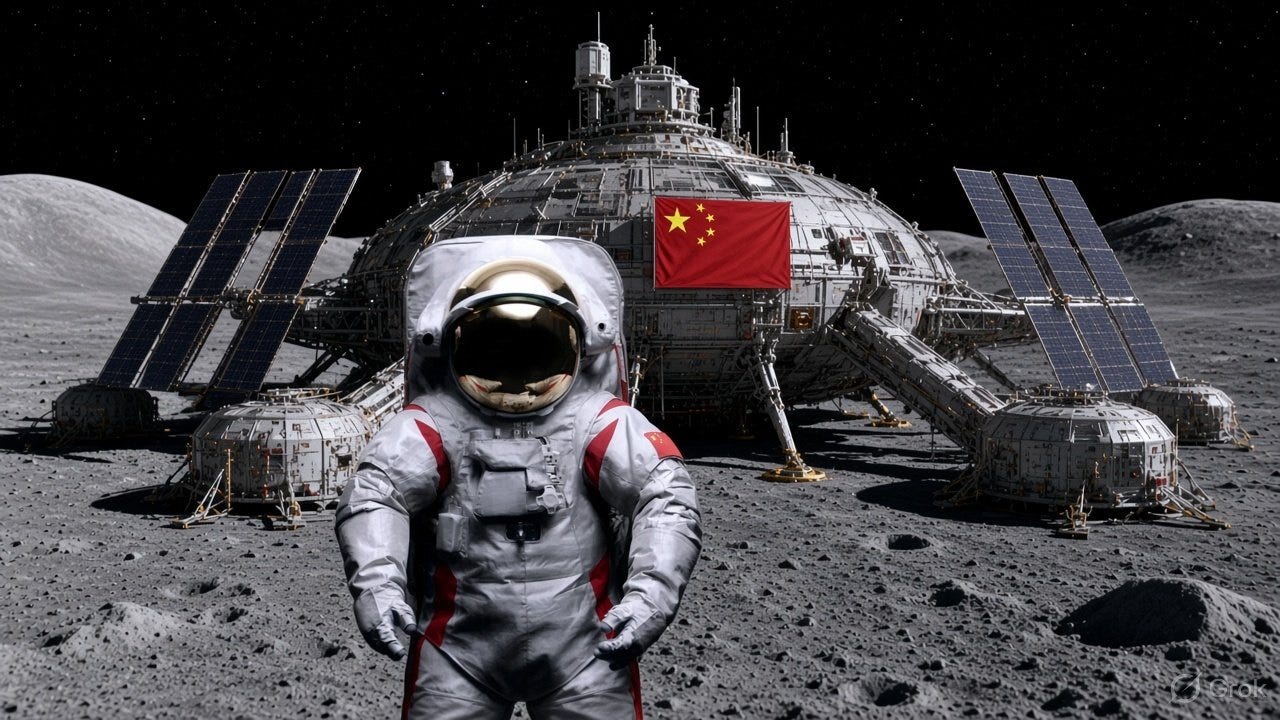
Beyond the first footprints lies the larger design. The International Lunar Research Station, planned for the south polar region, is meant to become a permanent foothold, first robotic, then human. Partners have been courted carefully, yet the core remains Chinese. Resource utilization experiments, communications networks, and power systems are already in the planning stages. The Moon is not treated as a destination for brief visits and flags. It is treated as territory to be occupied, studied, and eventually exploited. In this vision, the old romanticism of exploration yields to something more elemental: the extension of sovereign control into the void. The hunger is visible in every successive robotic precursor, every test that chips away at remaining technical barriers. Delay is unacceptable. Defeat is unthinkable.
Mars follows in the same relentless sequence. The Tianwen series has already delivered an orbiter, lander, and rover. The next step is sample return, targeted for launch in the late 2020s with material arriving on Earth early in the following decade. If the schedule holds, China could become the first nation to place Martian rock in terrestrial laboratories. Asteroid missions are underway. Outer planet concepts are under study. Each success feeds the next. The program does not pause to celebrate. It simply continues, absorbing data, refining hardware, and expanding the map of reachable worlds. The state does not ask whether these goals are worth the cost. It has already answered that question in the affirmative, and the answer is measured in prestige, technological sovereignty, and the quiet assertion that the future of the solar system will not be written solely in English.
What makes this ascent unsettling is not any single mission but the nature of the engine driving it. China’s space program is an instrument of the state, insulated from the electoral cycles, budget battles, and commercial negotiations that shape American efforts. Decisions are centralized. Resources are allocated according to long-term strategy rather than quarterly results. Failure is absorbed and corrected without the spectacle of public recrimination. The result is a competitor that does not tire, does not fragment, and does not need to justify its ambition to a skeptical legislature. It simply builds. Year after year, launch after launch, the distance between aspiration and capability narrows. The old bipolar contest has ended. In its place stands a new rivalry defined by one side’s willingness to treat the cosmos as a domain that must be claimed before others can consolidate their hold.
The Moon will be the proving ground. If Chinese boots touch the regolith first, or even arrive close behind with a clearer path to permanence, the psychological balance will shift. The narrative of American primacy in space, already strained by decades of shared stations and commercial dependence, will face its most serious challenge since Sputnik. Russia’s diminished role only sharpens the point. The competitor that matters now is the one that still believes space can be won, and that is prepared to spend whatever is required to win it. In the quiet rooms where trajectories are calculated and hardware is tested, that belief is not theoretical. It is operational. And it is hungry.