

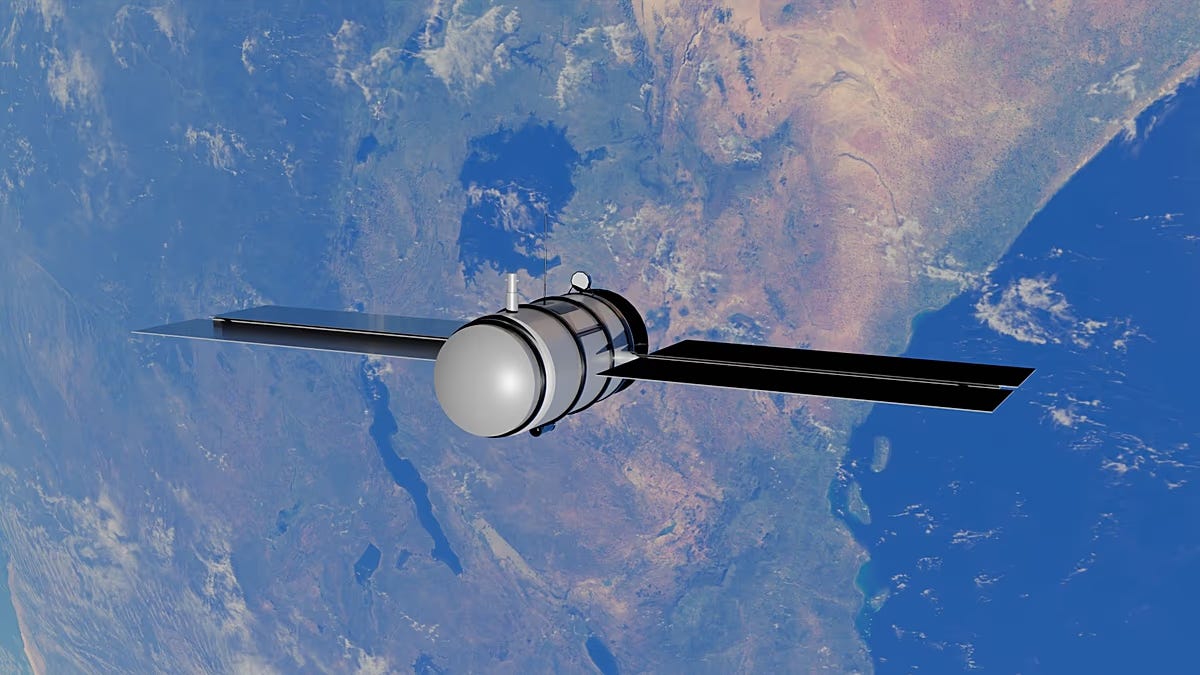
China is quietly pulling ahead in one of the most strategically important races of the decade, and the evidence is no longer theoretical. While American companies debate architectures and file patents, Chinese satellites are already training artificial intelligence models in orbit, rejecting heat through giant deployable radiators, and linking themselves with laser beams at the edge of space. The latest proof arrived on 14 October 2026, when a LandSpace Zhuque-2E rocket lofted eight more ADA Space computing satellites into a dawn-dusk sun-synchronous orbit. Those spacecraft joined roughly a dozen predecessors already circling Earth, bringing the operational total near twenty. Each carries high-performance processors, ten-kilowatt-class liquid cooling loops, and expansive radiative panels designed to dump the intense heat of continuous computation into the cold of space. The constellation is called Star Compute, or Xingsuan, and its ultimate ambition is breathtaking: 2,800 satellites, of which 2,400 will handle inference and 400 will train foundation models, delivering a claimed aggregate capacity measured in the hundreds of thousands of petaflops.
This is not a publicity stunt. The satellites are already performing the very tasks that terrestrial data centres struggle with. Earlier batches have run Chinese large language models in orbit and even demonstrated remote control of ground-based robots using space-borne inference. The newest group will push further, testing full inter-satellite laser networking and sustained foundation-model training under real orbital thermal loads. No American system has matched this operational tempo. SpaceX has spoken publicly about eventual orbital AI data centres, and various Silicon Valley startups have sketched elegant concepts that leverage Starlink’s laser mesh or Starship’s massive payload capacity. Yet as of late 2026 those ideas remain largely on whiteboards and in slide decks. The United States still leads in overall satellite numbers and launch cadence, but in the specific domain of space-based computing hardware that is actively training models and dissipating kilowatts of heat, China is flying while America is still planning.
The motivations behind China’s push are layered and deliberate. At the highest level sits the national determination to lead in artificial intelligence. Beijing views compute as the new oil, and orbital platforms offer a way to generate that compute without the political and physical constraints that bind terrestrial facilities. Space provides essentially unlimited solar energy and a perfect heat sink. There is no need to negotiate with local communities over power lines or cooling water, no vulnerability to drought or grid instability, and no easy path for foreign sanctions to interrupt supply. The dual-use potential is obvious: the same constellation that trains commercial models can support military surveillance, autonomous systems, or resilient command networks. China’s broader space strategy has long emphasised independence and technological leapfrogging; orbital data centres fit that pattern perfectly.
American motivations look different. They are driven more by commercial opportunity and competitive anxiety than by central planning. Companies such as SpaceX see orbital compute as a natural extension of their existing constellations and a potential high-margin business once Starship drives launch costs low enough. Tech giants facing soaring electricity bills and local opposition to new data centres are beginning to eye the sky as an escape valve. National security agencies understand the strategic implications, yet the American system moves through private capital, regulatory review, and incremental demonstration rather than coordinated five-year plans. The result is creativity and eventual scale, but slower initial deployment. Where China can direct state resources, state-backed companies, and launch providers toward a single goal, the United States relies on market signals that have only recently begun to align.
Energy realities sharpen the contrast. China continues to expand renewable generation at a ferocious pace, yet its electricity system remains under pressure from industrial demand and the explosive growth of terrestrial AI clusters. Coastal provinces already face seasonal power rationing. Orbital data centres sidestep those bottlenecks entirely. Once a satellite is aloft, sunlight is free and continuous in the right orbits, and waste heat radiates away without consuming a single litre of water or kilogram of coolant that must be trucked and maintained. The United States enjoys greater overall energy abundance and a more flexible grid in many regions, but it confronts a different set of constraints: soaring wholesale power prices in data-centre hubs, lengthy interconnection queues, and intensifying political resistance to large new facilities. American companies therefore also see orbital compute as attractive, yet the urgency feels less existential. China is building space data centres partly because its terrestrial energy and land constraints are already biting; America is exploring them because they might one day prove cheaper or more scalable.
The race is still young. Twenty Chinese satellites do not yet constitute a mature orbital cloud. Thermal management, radiation hardening, software reliability, and the sheer logistics of maintaining thousands of nodes all remain formidable. Launch costs must continue to fall, and inter-satellite bandwidth must prove robust under real traffic. The United States retains deep advantages in semiconductor design, software ecosystems, and the ability to iterate rapidly once prototypes fly. Starship, if it achieves the cadence SpaceX envisions, could deploy entire data-centre modules in single launches, potentially leapfrogging China’s distributed approach. Yet momentum matters. China has chosen to learn by flying, accepting the risks of early hardware in exchange for operational experience that no amount of simulation can fully replace. Every successful thermal test, every laser link locked, every model trained above the atmosphere compounds that lead.
What emerges is a classic contest between two different models of technological ambition. One is state-orchestrated, willing to absorb early costs and accept imperfect systems in pursuit of strategic position. The other is commercially driven, slower to commit physical assets but capable of sudden acceleration when the economics clarify. For now the satellites themselves tell the story. While American engineers refine PowerPoint architectures, Chinese processors are already humming in the vacuum, cooled by the blackness of space, training the algorithms that may shape the next decade of intelligence. The orbital data centre race is no longer hypothetical. It has a leader, and that leader is launching.