

In the quiet hours before dawn, when the world still feels half-asleep, it is easy to forget that one of the most useful metals on Earth has been hiding in plain sight for decades, locked behind an almost comically stubborn industrial process. Titanium sits as the ninth most abundant element in the planet’s crust and the fourth most abundant metal. There is no scarcity problem. Mountains of it exist in the form of rutile and ilmenite ores. What makes titanium expensive is not the digging; it is the refining. The industry still leans on the Kroll process, a method invented in the 1930s that has resisted meaningful improvement for more than sixty years. It is energy-hungry, slow, and wasteful, converting a significant fraction of the starting material into scrap. Analysts who have studied the chemistry closely suggest we are already near the practical cost floor of this particular sequence of reactions. Further incremental tweaks yield diminishing returns.
That floor begins to look movable once two forces arrive in earnest: abundant, cheap energy and capable robot labour. Energy is the larger lever. The Kroll process consumes vast quantities of electricity and heat. When solar power beamed from orbit, advanced terrestrial renewables, or fusion finally drive the price of a kilowatt-hour toward negligible levels, the dominant cost inside the titanium plant shrinks dramatically. Robot labour matters too, but in a supporting role. Continuous, precise, tireless operation can tighten yields, reduce human error, and keep the furnaces running without the interruptions and overhead of shift work. Together they transform titanium from a specialty material reserved for aerospace and high-end applications into something closer to a commodity. The metal that once commanded a premium simply because it was hard to purify becomes ordinary in the best possible sense.
The Age of Abundance
Elon Musk has spoken of this broader transition in terms of “universal high income.” He argues that the productivity gains from artificial intelligence and humanoid robots will be so large that even a modest tax on the resulting economic output could fund generous distributions to everyone. The vision is not merely basic survival support; it is a high floor of material comfort made possible by machines that never tire and energy that costs almost nothing to produce. The technological side of the claim is straightforward. The distributional side is not automatic. History shows that productivity gains from automation often concentrate among those who own the capital—the robots, the factories, the patents—unless deliberate policy intervenes. An era of plenty is therefore possible, but only if societies choose to share the surplus rather than allow it to pool in fewer hands. That choice remains political and legal, not a guaranteed consequence of the technology itself.
Once titanium becomes inexpensive, its practical virtues become available at scale. The metal forms a stable, self-healing oxide layer that shrugs off seawater corrosion in a way ordinary steel never can. Combined with an exceptional strength-to-weight ratio, it is the reason serious deep-diving submersibles use titanium pressure hulls. The hull of a vessel like Triton’s Limiting Factor can endure repeated extreme-depth cycles far longer than steel would manage before corrosion becomes the limiting factor. Metal fatigue from pressure cycling still exists, of course, and seals, electronics, and other systems will wear out first. Yet a titanium structure can outlast most of the vessel’s other components by a wide margin. In an age of cheap titanium, the idea of personal submarines or ocean-going yachts that remain structurally sound for decades, perhaps even a century or more with proper maintenance, stops sounding like science fiction. Average people could, in principle, own vessels that last longer than their own lifetimes. The sailing cruiser Titan Lady which was made entirely out of titanium by designer/builder/owner Eiichi Imai, who owns the metal-fabrication facility Nissei Industrial in Japan, would no longer stand as an isolated curiosity; it would become a prototype for a more common class of long-lived craft.
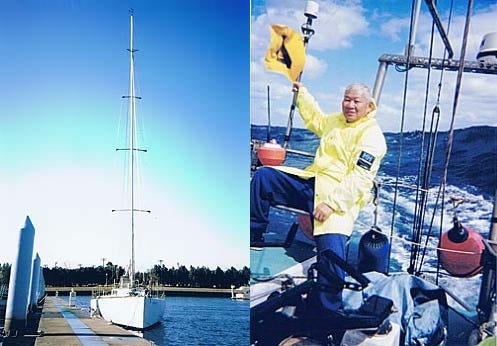
The 42′/12.8m Titan Lady built in 1997 stands alone as a unique all-titanium yacht
Personal Submarines
Even budget submarines become feasible in an age of abundance where titanium is affordable to refine and weld. A concept which until now has been limited to the Russian Military and deep sea exploration. The Soviet Union constructed their revolutionary Alfa-class attack submarines and subsequent titanium vessels, including modern specialized spy submarines by re-engineering the traditional shipbuilding process.
Titanium possesses an exceptional strength-to-weight ratio, providing the same structural durability as high-yield steel at roughly half the weight. This extreme lightness allowed Soviet designers to create smaller, highly streamlined vessels that achieved unmatched underwater speeds and carried powerful, high-density reactors without becoming too heavy. More importantly, the immense tensile strength of titanium enabled these submarines to withstand staggering deep-sea pressures, allowing them to operate at depths exceeding 2,000 feet—well below the reach of contemporary Western anti-submarine weapons and deep enough to out-dive standard steel-hulled vessels. As an added tactical advantage, titanium is non-magnetic, making these hulls nearly invisible to Western magnetic anomaly detection sensors.
While the United States abandoned the concept of massive titanium hulls due to the exorbitant cost of the raw material, a lack of domestic ore reserves, and the sheer logistical nightmare of shaping the metal, the Soviets leveraged their abundant domestic titanium supplies and advanced metallurgy infrastructure. The primary obstacle that had caused Western engineers to give up was the extreme difficulty of welding large titanium plates. When titanium is heated to its melting point, it reacts violently with oxygen and nitrogen in the air, absorbing these gases and causing the welds to become brittle, structurally compromised, and highly prone to cracking under ocean pressure.
Soviet engineers solved this metallurgical challenge by abandoning standard open-air shipyards entirely. They constructed massive, hermetically sealed assembly warehouses that were completely evacuated of normal air and flooded with pure, inert argon gas. Because humans cannot survive in an argon atmosphere, shipyard welders had to be outfitted in pressurized, oxygen-supplied suits resembling cosmonaut gear to perform the delicate work. A job that would now be perfect for robots should titanium become cheap enough to replace steel.
This hyper-controlled environment effectively shielded the molten metal from atmospheric contamination, allowing technicians to achieve flawless, multi-layered welds on a massive scale. Although this radical approach required immense funding, extraordinarily tight tolerances, and specialized training, it allowed Russia to master large-scale titanium fabrication decades before the rest of the world.
Underwater Cities
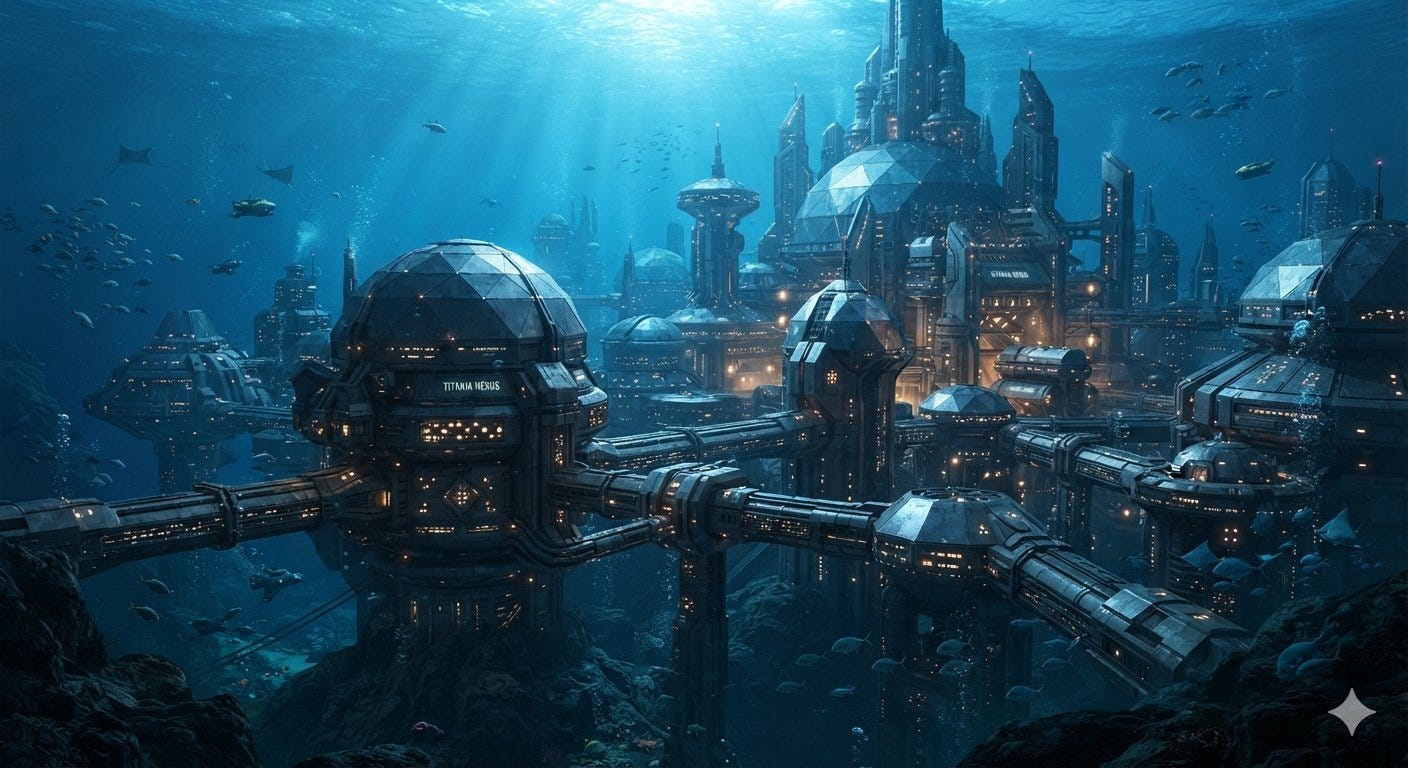
The larger implication is almost geological in scale. Nearly seven-tenths of the Earth’s surface is ocean, currently unused for permanent human habitation. Cheap, corrosion-resistant titanium changes the economics of building there. Pressure hulls, structural frames, and exterior surfaces that do not slowly dissolve in salt water make underwater and floating cities far more practical. Energy harvested from waves, currents, or floating solar arrays could power them. Robot labour could construct and maintain the habitats with far less risk to human workers. The ocean would cease to be a barrier and become an extension of livable territory. Humanity would gain not just more square kilometres but an entirely new relationship with the planet’s dominant environment.
None of this arrives overnight. The Kroll process will not vanish in a single year, and the social questions around distributing abundance will require hard political work. Yet the direction of travel is visible. When energy becomes nearly free and machines handle the repetitive, dangerous, or precise labour, materials once constrained by process costs open up. Titanium is simply one of the clearest examples. A metal that has always been plentiful in the ground finally becomes plentiful in the hands of builders, designers, and ordinary people. The oceans wait, vast and underused. The tools to inhabit them more fully are beginning to look affordable. In that future the cost of refining titanium is no longer a quiet industrial footnote; it is one of the quiet hinges on which a larger age of abundance can turn.