

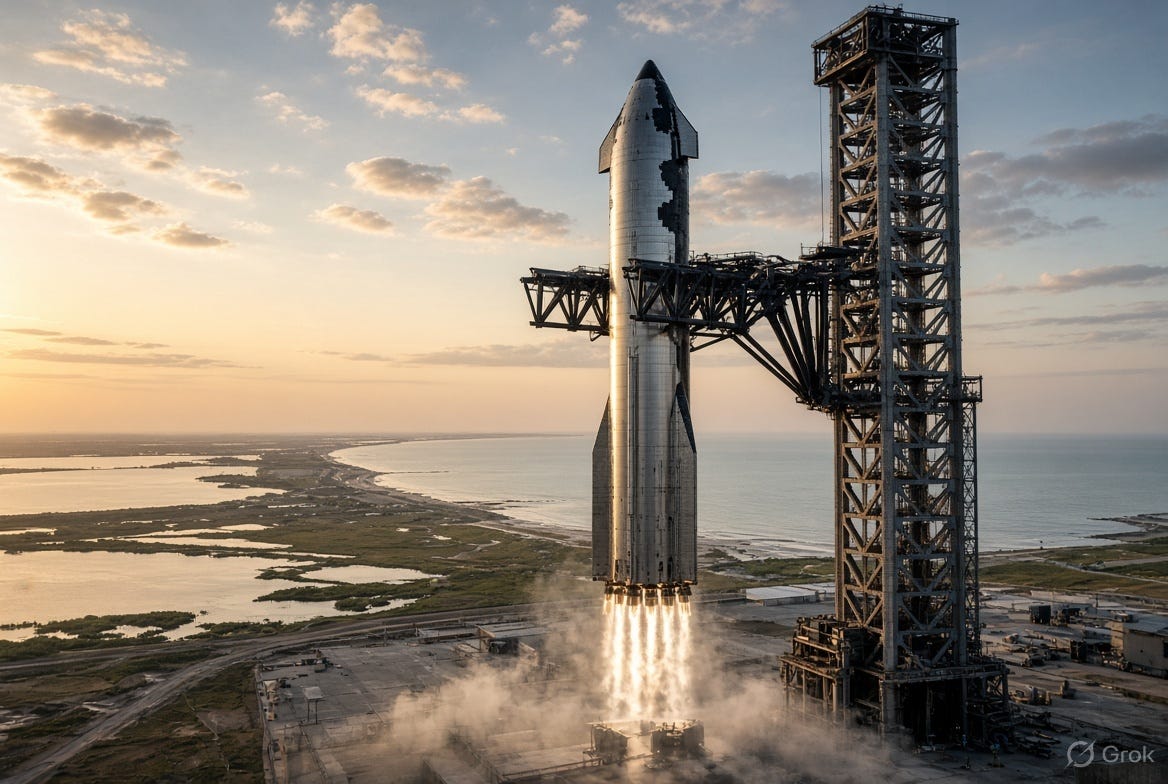
Friday the 13th has always been the calendar’s most theatrical day, a date that invites black cats, broken mirrors, and the quiet suspicion that the universe is quietly loading a practical joke. This year SpaceX has decided to lean all the way into the superstition by scheduling Starship Flight 15 for exactly that date, complete with an attempt to catch both the booster and the ship at the same Texas tower. If the universe really is keeping score, this is the moment it stops pretending to be subtle.
The plan itself is almost comically ambitious. Sometime in a seventy-five-minute window that opens at 4:45 in the afternoon local time, a gleaming stainless-steel tower of methane and liquid oxygen will light thirty-three Raptor engines and climb away from Pad 2 at Starbase. Roughly six and a half minutes later the Super Heavy booster, now flying its first catch attempt in the newer V3 configuration, is supposed to return, flip, and settle neatly between the giant mechanical arms everyone still calls chopsticks. That part, while never routine, is at least familiar. SpaceX has already caught earlier boosters three times. The real drama, the part that feels like someone in mission control lost a bet with the cosmos, arrives more than twenty-two hours later.
After deploying twenty-six Starlink V3 satellites and completing roughly fourteen orbits, Ship 42 is expected to fire its engines, slice back through the atmosphere, flip upright, and attempt to park itself in the same pair of arms that earlier caught its booster. No Starship upper stage has ever been caught. The vehicle will have to survive the heat of reentry, remain healthy enough to pass a series of automated safety checks, and then thread itself into a mechanical embrace while traveling at terminal velocity. If it works, SpaceX will have achieved the first full recovery of an orbital launch system. If it does not, the Gulf of Mexico or the Indian Ocean will receive another stainless-steel visitor, and the internet will spend the next week producing memes about Friday the 13th curses.
There is something deeply human about choosing this particular date. Superstition is usually the province of people who avoid ladders and refuse to open umbrellas indoors. Rocket engineers are supposed to be the opposite: cold-eyed calculators of probability who treat black cats as irrelevant variables. Yet here they are, loading a first-of-its-kind dual catch onto the one day of the year that folklore insists is statistically cursed. It feels less like engineering and more like performance art. The universe has been invited to do its worst, and SpaceX has politely asked it to hold the microphone while the chopsticks do their thing.
The hardware itself carries its own quiet comedy. Booster 22 and Ship 42 are the latest Block 3 vehicles, refined after earlier flights that managed to reach orbit but still occasionally reminded everyone that Raptor engines can be temperamental divas. The ship will spend more than twenty-two hours circling the planet at roughly 275 kilometers altitude, giving three of the Starlink satellites onboard cameras a chance to inspect its heat shield in exquisite detail. One imagines the satellites sending back high-resolution photos of tiles that look perfectly fine, while somewhere on the ground a nervous engineer stares at the images and mutters that Friday the 13th is no time for optimism.
Watching the booster catch has become almost comforting in its violence. The vehicle returns under power, the arms close, the engines shut down, and for a moment the entire stack of metal hangs in the air like a very expensive, very loud piece of modern sculpture. The ship catch, if it happens, will be stranger. After more than a day in orbit the vehicle will reappear as a bright streak, slow itself with engine fire, and then attempt to land precisely where the tower expects it. The margin for error is measured in meters and milliseconds. Success would look like science fiction finally keeping its promises. Failure would look like the universe deciding that Friday the 13th still has some standards.
There is, of course, the small matter of regulatory approval still pending. The Federal Aviation Administration has been known to move at a pace that suggests it does not fully share SpaceX’s sense of theatrical timing. Weather in South Texas in mid-November can also develop opinions of its own. Any number of technical holds could push the attempt into the following days, stripping the event of its perfect superstition branding. Yet the fact that the company is even willing to aim for the date says something about the current state of the program. Confidence, or at least the performance of confidence, has grown large enough that Friday the 13th no longer feels like an unlucky coincidence. It feels like a dare.
If both catches succeed, the day will be remembered as the moment full reusability stopped being a slide in a presentation and became a physical fact. Future flights will look less like experimental tests and more like the beginning of a transportation system that treats Earth orbit the way airlines treat Atlanta. If only the booster is caught, the mission will still advance the program. If neither is caught, the data will still be valuable and the ocean will once again prove itself an excellent, if expensive, landing pad. In every outcome the stainless-steel vehicles will have done what they were built to do: go up, come down, and give the people watching something to talk about.
Friday the 13th has spent centuries accumulating bad press. This particular one has a chance to rewrite the brand. A giant rocket leaving Texas in the late afternoon, a booster returning minutes later into mechanical arms, and then, after an entire night and most of the next day, a second vehicle attempting the same precise catch after circling the planet fourteen times. The universe is welcome to send black cats, broken mirrors, or unexpected weather. SpaceX has already decided the show will go on, superstition or no superstition. Whether the chopsticks close around both stages or only one, the day will still belong to the people who looked at Friday the 13th and decided it was the perfect time to try something that had never been done before.