

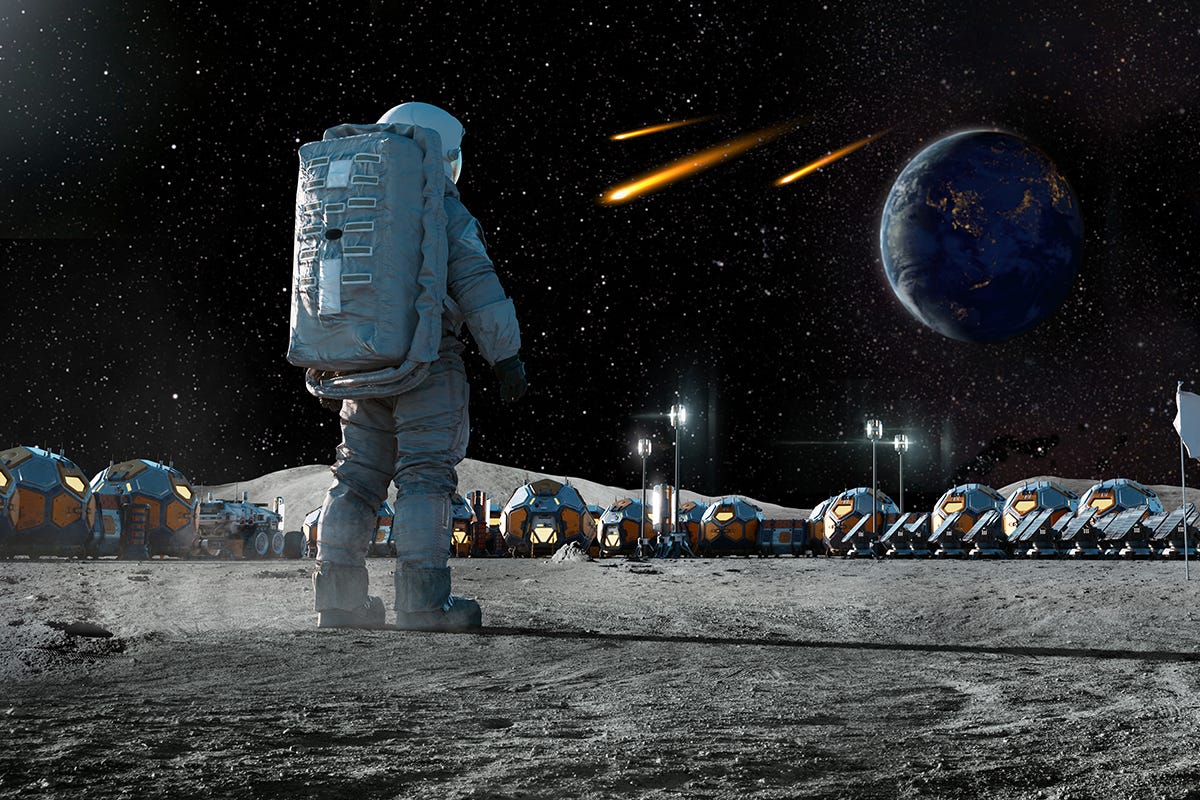
Near the Moon’s south pole, where sunlight skims the crater rims for weeks at a time and permanent shadows hide ancient ice, NASA intends to establish humanity’s first enduring foothold beyond Earth. The agency calls it simply Moon Base—an intentionally plain name for an ambitious, multi-decade effort to turn short visits into sustained presence.
Announced in March 2026 during NASA’s “Ignition” event, Moon Base marks a clear shift in strategy. Earlier concepts that emphasized an orbiting Gateway station have been deprioritized. Resources are now concentrated on the surface itself. The goal is straightforward: learn how to live and work on another world, extract local resources, conduct science that cannot be done from orbit, and prepare the techniques needed for eventual crewed missions to Mars.
A Phased Path to Permanence
NASA has outlined a three-phase approach. Phase 1, already underway and running through roughly 2029, focuses on reliable access and experimentation. A series of robotic landers—many provided through commercial partnerships—will deliver science instruments, technology demonstrators, and early infrastructure. Missions designated Moon Base 1, 2, and 3 are among the first. Blue Origin’s Blue Moon Mark 1 lander, Astrobotic’s Griffin, Intuitive Machines vehicles, and others will test precision landing, plume-surface interactions, mobility, and power systems in the harsh polar environment.
Phase 2 (approximately 2029–2032) aims to establish initial operating capability. This stage is expected to introduce more substantial surface assets: lunar terrain vehicles capable of crewed and autonomous operation, additional habitats or pressurized volumes, and the beginnings of a power and communications network. Phase 3, targeted for the early-to-mid 2030s, seeks continuous human presence, supported by nuclear fission power and the ability to extract and process local resources.
The scale is significant. Public briefings have described dozens of launches and landings over an 11-year window, along with rovers, hopper drones for regional survey, and habitat modules. Exact numbers and budgets will evolve with congressional funding and technical progress, but the direction is clear: frequent, iterative deliveries rather than a single monumental construction campaign.
Why the South Pole?
The choice of location is driven by physics and resources. Elevated sites near Shackleton Crater and the Connecting Ridge (sometimes called the Shackleton–de Gerlache Ridge) offer near-continuous sunlight for solar power while remaining close to permanently shadowed regions that are believed to contain water ice. That ice is the strategic prize. Processed into oxygen and hydrogen, it can supply breathing air, drinking water, and rocket propellant. In the language of mission planners, water is “the oil of space.” Producing propellant on the Moon rather than launching it from Earth dramatically changes the economics of cislunar operations and deep-space travel.
Early robotic missions are already targeting these areas. Landing site studies continue to refine exact coordinates, balancing illumination, slope, communication lines of sight to Earth, and access to cold traps. The precise footprint of the eventual base will likely spread across multiple nearby sites rather than a single compact compound—an “outpost complex” measured in square kilometers rather than a single habitat cluster.
Commercial Partners and Technical Realities
Moon Base is not a purely government construction project. NASA is relying heavily on commercial providers for landers, rovers, and cargo delivery. SpaceX and Blue Origin are developing human-class landing systems. Companies such as Astrolab and Lunar Outpost are building lunar terrain vehicles. Firefly and others are contributing hoppers and additional delivery capacity. This model spreads risk and aims to create a sustainable transportation cadence.
Significant challenges remain. Lunar dust is abrasive and electrostatically charged. The two-week night at lower latitudes is avoided at the poles, but thermal extremes and radiation still demand robust systems. Power, especially through the occasional eclipse seasons or for energy-intensive resource processing, will require a mix of solar and eventual nuclear sources. Precision landing and surface mobility in uneven, poorly lit terrain must be demonstrated repeatedly. And the timelines are aggressive; history shows that complex space architectures often slip.Yet the underlying logic is sound. Each successful robotic delivery reduces risk for the crews that will follow. Each technology demonstration—whether oxygen extraction from regolith, ice prospecting, or autonomous navigation—builds the operational experience required for longer stays.
Looking Ahead
If the plan holds, the late 2020s will see the first sustained robotic presence near the south pole, followed by short crewed visits that grow in duration. By the mid-2030s the base could support continuous occupation, scientific laboratories, and the first meaningful production of local propellant. From there, the Moon becomes a proving ground and a logistics node for the harder journey to Mars.
Moon Base is still early. Site selection is not final, hardware is still in development, and budgets must be sustained across multiple administrations and Congresses. But the shift in emphasis—from flags-and-footprints to infrastructure—is unmistakable. For the first time, NASA is designing not just to arrive on the Moon, but to stay.
The south polar highlands are cold, bright, and waiting. The work of turning them into a place where people can live has begun.