

For more than half a century the lunar surface has waited in silence. The last footprints left there belong to Gene Cernan and Harrison Schmitt, pressed into the gray dust of the Taurus-Littrow valley in December 1972. Since that day no human has stood on another world. The Moon has continued its slow orbit, the Earth turning through day and night and season below it, while people remained confined to low Earth orbit or the surface of their home planet. That long absence is about to end.
The path back has never been simple. Rockets of immense power must rise from Florida. Spacecraft must carry crews farther than any living astronaut has traveled. Landing systems must touch down on an airless world whose surface temperature swings between extremes that would shatter ordinary machinery. And all of it must be done with the care and precision that only decades of hard-won experience can provide. Under the current architecture of the Artemis program, that careful progression leads through two critical missions: Artemis III and Artemis IV.
Artemis III will not place boots on the Moon. Instead it will perform the essential work of preparation in the relative safety of low Earth orbit. Four astronauts will launch aboard the Orion spacecraft atop a Space Launch System rocket and meet one or both of the commercial lunar landers now under development. In the familiar environment of Earth’s neighborhood they will practice the delicate choreography of rendezvous and docking, test life-support systems under real conditions, evaluate the new generation of spacesuits, and prove that the complex machinery of a future landing can operate as a single, reliable whole. It is a mission of rehearsal, of muscle memory rebuilt, of risk reduced before the stakes become absolute. By validating these systems close to home, Artemis III clears the way for what follows.
That next step is Artemis IV, the mission that will return human footsteps to the lunar surface. Targeted for early 2028, it carries the weight of history and the promise of a new beginning. After launching from Kennedy Space Center, the crew of four will travel to lunar orbit. There, two astronauts will transfer into a waiting human landing system—either a variant of SpaceX’s Starship or Blue Origin’s Blue Moon—and descend through the vacuum to touch down near the Moon’s south polar region. For approximately one week they will live and work on that alien ground while their two crewmates remain in orbit.
Life inside the lander will be both extraordinary and strangely ordinary. The vehicle itself becomes their home, a pressurized metal island on an airless plain. Compared with the cramped Apollo lunar modules of the 1960s and 1970s, these modern landers offer far greater volume. The astronauts will be able to stand upright, move about with relative ease in the Moon’s one-sixth gravity, and remove their suits when not outside. The lander’s systems will keep them alive through careful control of every vital need. Oxygen will be supplied and carbon dioxide scrubbed from the air. Temperature will be regulated against the brutal swings between the heat of lunar day and the deep cold of lunar night. Radiation shielding, water recycling, food storage, and waste management will all operate in the quiet of a sealed cabin, the only sounds the soft hum of fans and the occasional radio call from Earth. Outside the windows the landscape will be stark and still: rolling hills of fine gray dust, ancient craters, and, in places, the permanent shadows where sunlight has never reached.
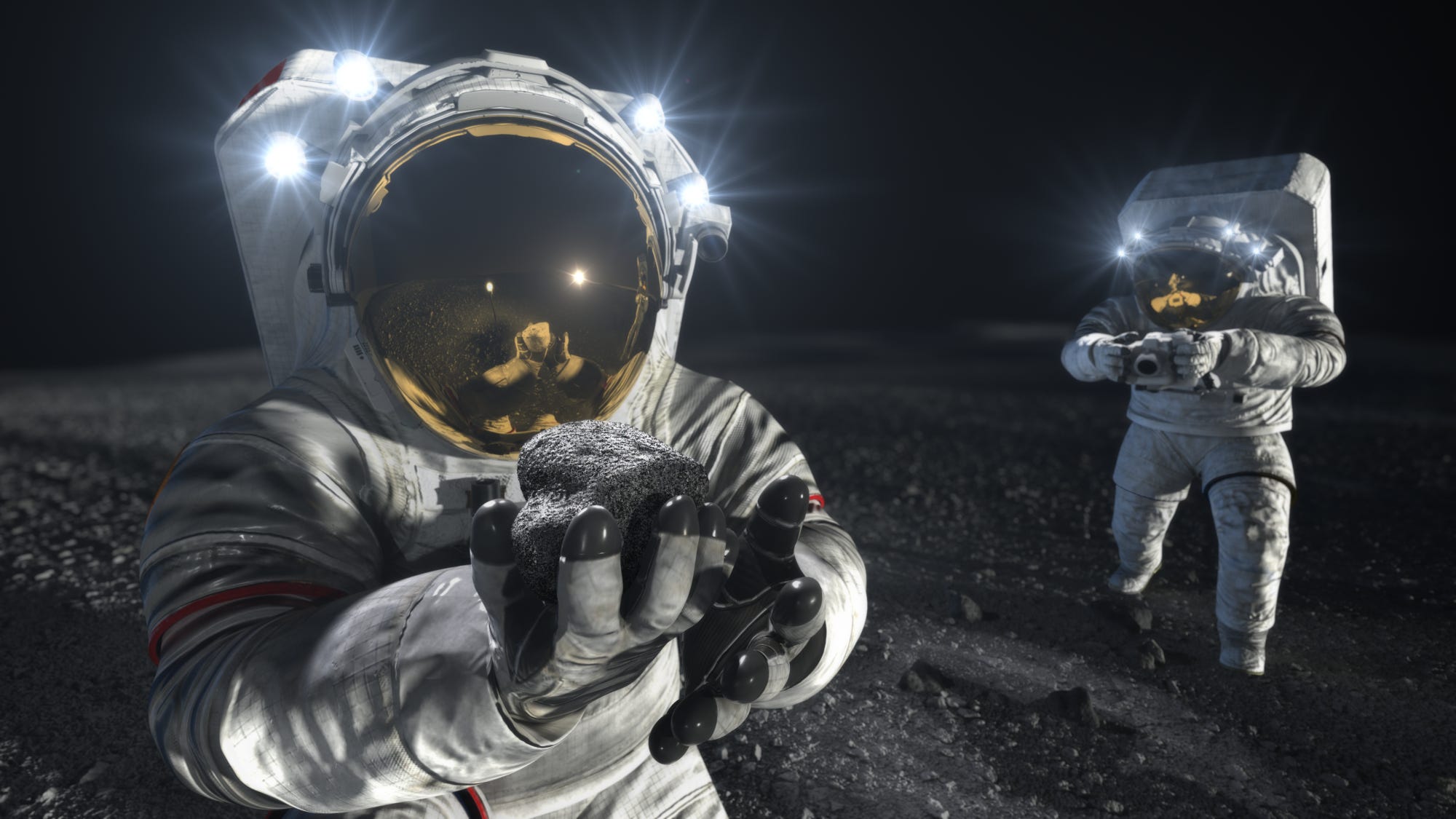
When they step outside, the work begins in earnest. The astronauts are expected to conduct two to four extravehicular activities, or moonwalks, over the course of their stay. They will collect carefully documented samples of rock and soil, paying special attention to material from permanently shadowed regions that may contain water ice locked away for billions of years. They will deploy scientific instruments, among them a compact seismic station designed to listen for moonquakes and meteorite impacts long after the crew has departed. They will photograph and map the terrain, test the performance of their advanced spacesuits in real conditions, and evaluate how well tools and procedures work in the low gravity and abrasive dust. Every observation will help refine understanding of the south polar region’s resources and hazards.
This first landing also serves a larger purpose. The south polar sites under consideration are not chosen solely for science. They are among the leading candidates for the future Moon Base that NASA and its partners intend to establish in the coming decade. The astronauts of Artemis IV will gather the practical knowledge—how the dust behaves under boots and machinery, how the lighting and temperature vary across short distances, how communications and navigation perform—that will shape decisions about where permanent habitats, power systems, and landing pads should one day stand. Their week on the surface is both an exploration in its own right and a reconnaissance for everything that follows.
There will almost certainly be moments of pure human entertainment as well. The Apollo astronauts discovered that even the most serious exploration left room for a little fun. On later missions they pushed their electric lunar rover hard across the dusty plains, testing its limits in what they cheerfully called the Grand Prix.
Alan Shepard attached a golf-club head to a sampling tool and swung it at two balls. The first sailed about twenty-four yards into a nearby crater; the second traveled roughly forty yards. Shepard later claimed with a grin that one had gone “miles and miles”. The Artemis crews might continue that same light-hearted tradition. Between the structured science tasks they may well find a few moments to stage a first ever lunar sporting event of their own—perhaps the first volleyball match ever played on another world—adding a new entry to the unofficial Guinness Book of Moon records.
When the surface work is complete the two astronauts will climb back into their lander, seal the hatches, and ascend to rejoin their crewmates in orbit. The four will then begin the long journey home, carrying with them the first new samples of lunar material collected by human hands in more than fifty years, along with the knowledge that the silence has been broken.
The Moon has waited long enough. In the careful sequence of Artemis III’s preparation and Artemis IV’s arrival, that wait is drawing to a close. The boots that will press into lunar dust in 2028 will carry more than the weight of the astronauts who wear them. They will carry the hopes of a generation that has never seen a human walk on another world, and the determination of those who refused to let the dream fade.
NASA will provide a major update on this work on Friday, October 23, sharing the latest progress on Artemis III and the path that leads to Artemis IV and the return of boots to the Moon.