

For years, the public perception of humanoid robotics was defined by viral videos of backflips, followed by clips of spectacular, joint-shattering falls. These were pre-programmed triumphs—brilliant feats of traditional mechanical engineering, but structurally blind to the chaotic, unpredictable nature of the real world.
That era is officially over.
We have entered the age of Athletic Physical AI, a paradigm shift where advanced neural networks are married to hyper-responsive hardware. Instead of executing pre-scripted code, robots are now sensing, reasoning, and reacting to physical environments in real time. They are mastering tasks that require high-speed coordination, microsecond reflexes, and human-level intuition.
From Virtual Classrooms to the Tennis Court
Nowhere is this evolution more obvious than on the sports court. In a recent milestone collaboration, researchers utilized a modified Unitree G1 humanoid to tackle the complex physics of human-versus-robot tennis.
Unlike chess or video games, tennis cannot be solved by brute-force digital calculation alone. It requires tracking a spinning object, predicting its trajectory, adjusting one’s own physical mass, and executing a precise mechanical strike—all within milliseconds.
The breakthrough came via advanced Sim-to-Real (Simulation-to-Real) training. The robot spent the equivalent of years training inside a hyper-accelerated virtual physics simulator, experiencing millions of erratic ball trajectories. When deployed on a physical court against real human players, the AI-driven humanoid achieved an astonishing 90.9% success rate on forehand returns and 77.8% on backhands, dynamically adjusting its stance to counter unpredictable human spin.
Similarly, at recent tech expositions, AGIBOT’s A3 Ultra demonstrated flawless, fluid table tennis rallies completely autonomously. Without a single human operator or remote guide, the robot’s vision-language-action (VLA) models calculated the tiny ping-pong ball’s speed and spin, returning volleys with the organic grace of a seasoned athlete.
Moving Beyond the Human Blueprint
As Physical AI matures, engineers are realizing a liberating truth: humanoids do not need to be limited by human anatomy.
The newly deployed electric Boston Dynamics Atlas embodies this “alien athleticism.” While it retains a humanoid silhouette, its joints are engineered to rotate a full 360 degrees without restriction. Powered by an AI brain that understands spatial mechanics, the new Atlas doesn’t bother turning its whole body around to pick up a heavy factory crate. Instead, it twists its hips, shoulders, and neck into orientations that would break a human spine, moving with a chillingly efficient, post-human fluidity designed purely for optimal logistics.
The Brains and Tactile Beauty Behind the Brawn
This athletic explosion is fueled by two massive technological convergence points:
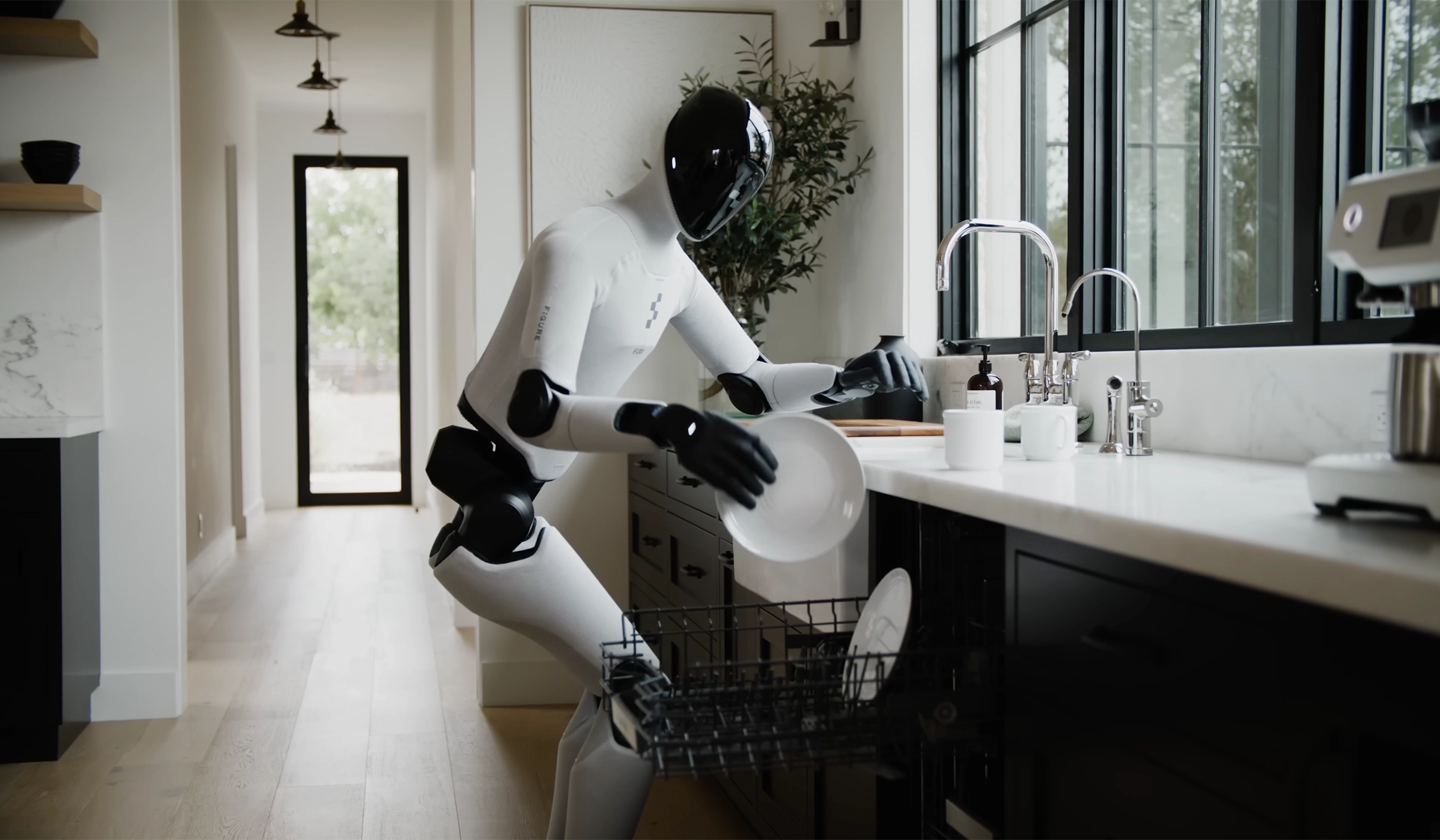
Zero-Shot Spatial Reasoning: Powered by multimodal models like Figure’s Helix system, modern humanoids possess semantic understanding of the physical world. If you tell a robot “I spilled my drink,” it doesn’t need a specific command to fetch a towel. The Physical AI interprets the problem, scans the room for an absorbent material, plots an agile path around furniture, and deploys its motor controls to clean the mess.
The Tactile Revolution: Athleticism is nothing without control. Advanced humanoids are shedding rigid plastic digits for bio-inspired tactile hands. Startups like Gento Robotics are utilizing thousands of micro-pressure sensors embedded in robotic fingertips. This allows the AI to instantly feel surface friction and weight, enabling a multi-hundred-pound robot to pluck a fragile strawberry or a raw egg out of mid-air with the exact micro-finesse required not to crush it.
The “Data Farms” Weaponising Movement
The true secret weapon of Athletic Physical AI is data. Just as early large language models were fed the entirety of the internet’s text, companies like Spirit AI are now running massive physical data farms.
Thousands of human contractors wearing motion-capture suits are logging hours of real-world movement—running, slipping, catching their balance, lifting awkward objects, and navigating cluttered spaces. This vast repository of human kinetic data is fed directly into neural networks.
The result? Robots are no longer just learning how to move; they are learning the intuitive, unwritten physics of our world.
A New Horizon
The transition of humanoids from rigid automation to fluid, athletic AI represents a massive leap forward for technology. As these machines master high-speed motor control, adaptive balance, and soft-touch manipulation, they cease to be mere tools. They are becoming active, capable participants in our physical world—ready to step into environments too hazardous, complex, or dynamic for traditional machinery to ever touch.