

For decades, deep-space exploration has been shackled by a single, multi-million-dollar bottleneck: the ground network. The standard playbook for sending a probe millions of miles into the void relies on an army of Earth-bound flight controllers monitoring thousands of telemetry metrics and beaming up sequential corrections in real-time. This model is exceptionally taxing, expensive, and fundamentally unscalable for the future of commercial off-world resource extraction.
Enter AstroForge, the Southern California-based asteroid-mining startup that is moving to completely upend the traditional aerospace operational framework. By unveiling Solo, an in-house developed, transformer-based autonomous control stack, AstroForge is chasing what its CEO Matthew Gialich directly calls the “holy grail of spacecraft engineering”—achieving true, uncommanded deep-space mission autonomy.
Breaking Free From the Ground Network
The inception of Solo stems from a pragmatic engineering trade-off. AstroForge has suffered its share of development setbacks, most notably the loss of communication with its Odin deep-space probe in early 2025. Facing a massive logistical forks-in-the-road, the startup realized it either had to invest roughly $200 million building a comprehensive global ground station antenna network to maintain links across deep space, or engineer a way to completely remove the vulnerability of the ground link itself.
They chose the latter. Solo is engineered to execute real-time decision-making without waiting for human intervention or Earth-based communications. For a company planning a sprawling, high-volume fleet of small, commercial vehicles tasked with rendezvous, landing on, and mining metal-rich M-type asteroids, human-in-the-loop navigation is an impossible economic model. Solo solves the scale gap. Where an agency mission might staff roughly 100 operators per eight-hour shift to navigate an asteroid rendezvous, Solo aims to do it autonomously with zero commands from Earth.
Inside the Solo AI Architecture
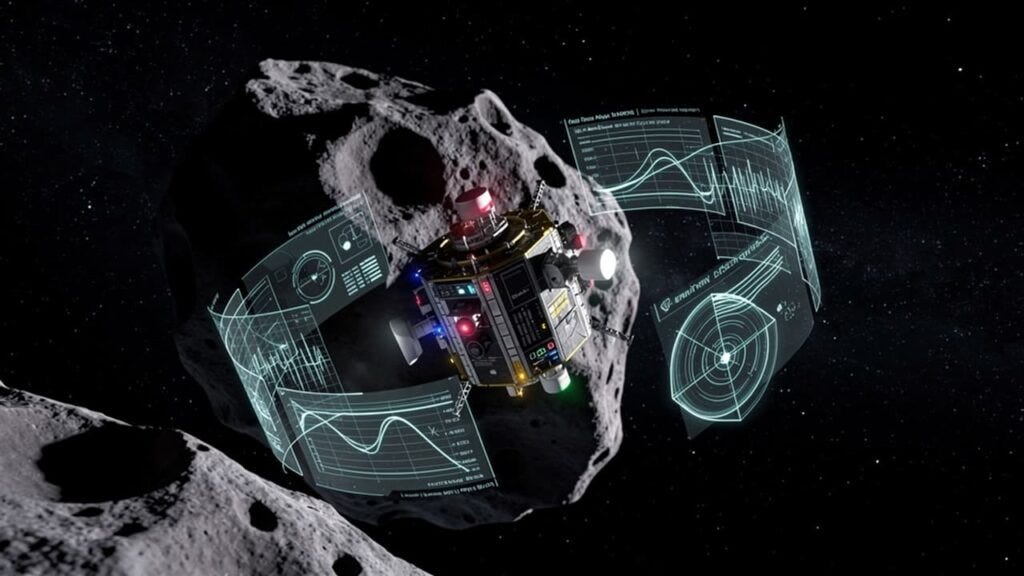
The system is not designed as an unconstrained general intelligence engine. Instead, it is a highly specialized, layered architecture tailored explicitly to the constraints of spacecraft health and survival. The deterministic base does not replace the traditional, physics-based flight control algorithms and Guidance, Navigation, and Control software. Instead, it acts as an intelligence layer that sits directly on top of them. Beneath this master layer are localized subsystem specialty models trained on specific test data to evaluate isolated spacecraft components, such as power generation arrays and thermal dynamics. The final cross-system reasoning stack is a constrained transformer model trained on roughly 2,500 onboard sensors. Because Solo is local, it can ingest and process immense volumes of real-time telemetry that could never realistically be downlinked to Earth, giving it a clearer overview of the spacecraft’s physical status than a human operator could ever achieve. This multi-tiered approach allows Solo to perform complex cross-system reasoning so that if an unexpected anomaly strikes deep in space, Solo can diagnose the systemic issue, isolate a failing component, and dynamically adjust its onboard operations to resolve the fault independently.
The Path to Full Autonomy
AstroForge is taking a calculated, stepwise approach to deploying its new control stack.
The software will take its inaugural flight in late 2026 aboard the company’s third vehicle, DeepSpace-2, which is scheduled to fly alongside Intuitive Machines’ third lunar lander mission. During this deep-space flight, Solo will run in “shadow mode”—meaning it will actively ingest all 2,500 sensor feeds and calculate operational decisions in real-time, but its commands will not be executed. The engineering team will use this run to meticulously validate Solo’s reasoning against actual deep-space flight data.
If shadow testing proves successful, the absolute ultimate test arrives in 2027 with the Autonomy-1 mission. Scheduled to launch on the inaugural flight of Stoke Space’s fully reusable rocket and backed by NASA to collect heliophysics data, Autonomy-1 will give Solo total control. The spacecraft is being intentionally designed to operate without any radio systems capable of receiving ground commands. From the exact microsecond it detaches from the launch vehicle, Solo will be entirely on its own.
A Paradigm Shift for Aerospace Engineering
If AstroForge proves that a constrained neural network can safely guide a commercial spacecraft through a complex outer-space itinerary, the paradigm of aerospace engineering shifts permanently. The reliance on immense infrastructure budgets and continuous communication links will give way to smart, self-contained, replicable hardware. By trusting localized intelligence to manage deep-space survival, AstroForge isn’t just making asteroid mining economically viable—they are building the blueprint for the next century of autonomous cosmic exploration.