

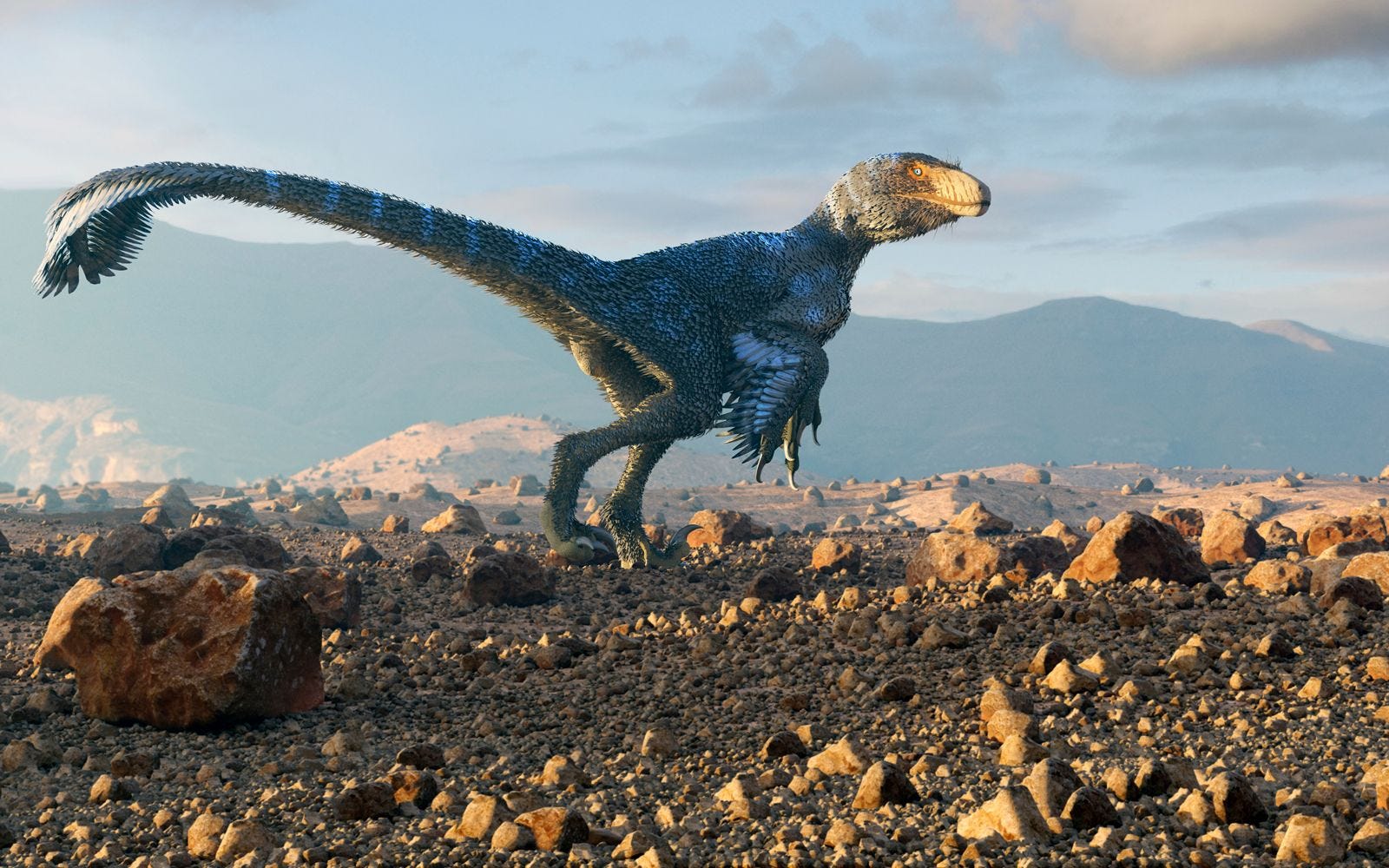
When we think of dinosaurs, we usually picture a massive Tyrannosaurus rex roaring into a primeval forest, or a long-necked Brachiosaurus shaking the ground with every step. We often talk about these creatures in the past tense, believing that a giant space rock wiped them all out 66 million years ago. But this common belief misses a spectacular truth. Dinosaurs never actually went extinct. Instead, they are singing in our backyards, flying over our oceans, and nesting in our trees.
The story of how dinosaurs survived and how they could one day rule the planet again is not science fiction. It is a matter of evolutionary history and biological potential. We are not living in a world that used to have dinosaurs. We are living in a world where dinosaurs are simply waiting for their next big chance.
The Feathered Survivors
The cataclysm that ended the Cretaceous period was unimaginable. An asteroid impact combined with massive volcanic eruptions choked the sky with ash, blocked out the sun, and collapsed the global food chain. The giant reptiles that had dominated the planet for over 100 million years could not survive the sudden, freezing darkness.
Yet, a small group of theropod dinosaurs did. These were the avians, the direct ancestors of modern birds. These creatures were small, active, and possessed a unique adaptation: feathers. While some of these ancient birds already flew, many of the survivors were actually small, ground-dwelling creatures. As the skies cleared and the planet slowly healed, these tough little survivors did something amazing. They re-evolved flight, spreading across a scarred world and diversifying into thousands of new shapes and sizes.
The Forgotten Second Age
We often assume that mammals immediately took over the earth once the giant reptiles died. In reality, the transition was far more competitive. During the millions of years following the asteroid impact, a second age of dinosaurs almost took hold. Giant, flightless birds emerged as top predators and herbivores on multiple continents.
In South America, the terror birds grew up to ten feet tall with massive, bone-crushing beaks. Across the globe, incredible creatures like the Elephant Bird of Madagascar and the towering Moa of New Zealand dominated their ecosystems. Mammals did not simply walk into an empty world and win. They had to compete with these feathered giants. Ultimately, it was the arrival of the ultimate mammalian predators, including humans, that suppressed this dinosaur uprising. In New Zealand, humans hunted the Moa to extinction, while similar fates befell giant birds elsewhere. The rise of mammals was not a guaranteed victory; it was a hard-fought battle.
Beyond the Jurassic Fiction
Millions of people are deeply familiar with the concept of prehistoric animals returning to our world thanks to Michael Crichton’s famous novel, Jurassic Park. The story captured the global imagination with its brilliant idea of scientists pulling ancient dinosaur DNA from the blood preserved inside prehistoric mosquitoes trapped in amber. It is a thrilling concept, but science has shown us that DNA breaks down over time and cannot survive for tens of millions of years.
Even if that technology really could be made to work, a true second age of dinosaurs would never need it. Nature does not need to resurrect ancient ghosts from test tubes when it already has the perfect raw material walking the earth today. Evolution does not just look backward. It moves forward. The living dinosaurs flying over our heads right now already possess the exact genetic foundation needed to grow, adapt, and reclaim the planet on their own, completely naturally, without a single strand of amber-preserved blood.
The Myth of Mammalian Superiority
Humans tend to look at evolution as a ladder, with mammals sitting naturally at the top. But nature does not favor mammals by default. For a long time, scientists believed that marsupials only succeeded in Australia because they were isolated from superior placental mammals. However, recent fossil discoveries have turned this theory upside down. Fossils show that placental mammals lived right alongside marsupials in ancient Australia. The marsupials did not win by default; they outcompeted the placental mammals on their own merits.
This discovery is crucial because it reminds us that biological victories are temporary. If birds ever find the right environmental conditions to make a major comeback, there is absolutely no guarantee that mammals will win a second time.
The Dinosaur Super-Weapons
If humans were to disappear, birds would enter a global arena with a set of biological tools that actually make them better suited for a changing planet than mammals. First and foremost is their respiratory system. Birds possess a highly efficient respiratory system made of air sacs that act like bellows, pump air continuously, and allow them to take in oxygen when they inhale and when they exhale. Mammals waste energy by breathing in and out of the same tube, but a bird has a one-way breathing highway. This lets them thrive in low-oxygen environments or during sudden atmospheric shifts caused by volcanic eruptions or runaway climate change.
Furthermore, birds excrete nitrogen waste as uric acid rather than liquid urine. This means they require significantly less water to flush toxins from their bodies, giving them a massive advantage during severe droughts or global warming events. Their feathers are also the most versatile insulation on Earth. They can keep a bird warm in an ice age or be adjusted to release heat in a desert. Combined with their ability to lay hard-shelled eggs that protect offspring from harsh outside environments, birds are biologically built to outlast mammals when the world goes chaotic.
The Next Giant Predators
So, which modern birds are waiting in the wings to become the next apex predators? The answers live among us today. Flightless giants like the Southern Cassowary of Australia already give us a terrifying glimpse of the past. Armed with five-inch, dagger-like claws on their inner toes and a bone-like helmet on their heads, cassowaries are living theropods. In a world without humans or large mammalian carnivores, these birds could easily grow to the size of automobiles, reclaiming their roles as forest-dwelling monsters.
On the open plains and savannahs, the Secretarybird is another prime candidate. This bird already hunts on foot, using a kicking force five times its own body weight to instantly crush the skulls of snakes and rodents. If they lose the need to fly, their legs could grow thicker, their bodies could grow heavier, and they could evolve into the next generation of running terror birds. Even smaller, highly intelligent birds like crows and ravens could adapt. Known for their problem-solving skills and social hunting habits, these birds could evolve into cooperative, ground-dwelling pack predators, acting much like the fictionalized Velociraptors of popular culture.
The Shifting Continents
Evolution never happens in a vacuum, and the very ground beneath our feet is constantly moving. Over the next fifty million years, continental drift will fundamentally reshape the planet, creating the perfect launchpad for a new dinosaur empire.
Throughout Earth’s history, islands have acted as evolutionary incubators. When a species of bird flies to an isolated island, it often finds a world free of large mammalian predators. Without the threat of being eaten on the ground, these birds quickly lose the need to fly because flying takes an immense amount of energy. They grow larger and heavier, taking over the roles of ground-dwelling animals like deer, cattle, or big cats.
As Africa continues to crash into Europe and Australia drifts steadily northward toward Asia, continental drift will close open seas and form massive land bridges. These movements will connect previously isolated islands to major continents. A giant, flightless bird that evolved in safety could suddenly find its territory opened up to the rest of the world. These new land pathways will allow giant avian predators to march across vast new terrains, invading areas where mammals have been weakened by climate shifts and outcompeting them on a global scale. The changing geography will essentially act as an escalator, lifting island-born giants into global conquerors.
The Path to a New Dinosaur Empire
If a global disaster were to occur, such as a nuclear war or a devastating pandemic that wiped out humanity, the global stage would reset. Another mass extinction event could easily wipe out the large mammals that currently dominate the landscape. In the aftermath of such a disaster, birds would have a distinct advantage. They are highly adaptable, they reproduce quickly, and they can travel vast distances across a ruined world to find safe havens.
Over millions of years, these surviving birds would settle into their new homes. As they adapt to fill the empty roles left behind by extinct mammals, they would lose their wings once more, growing into massive, walking titans. The forests and plains of a post-human world could easily fill with the sounds of giant, warm-blooded theropods.
A Hidden Majority
The most surprising fact of all is that we might not even need to wait for the future. Even today, there is a strong argument that we are still living in the age of dinosaurs. When we count the success of an animal group, we look at biodiversity. Today, there are roughly 6,000 species of mammals on Earth. In contrast, there are more than 10,000 species of birds.
By the numbers, dinosaurs still outnumber mammals by nearly two to one. The age of mammals might not be a permanent shift in Earth’s history at all. It may just be a brief, temporary blip in a grand story that has always belonged to the dinosaurs.